






Your Mission Deserves to Be Seen
Social impact campaigns run on trust, clarity, and the ability to reach the right people at the right moment.
AI is now the intermediary between the questions your audiences are asking and the answers they receive. That changes how purpose-driven marketers need to show up online.
This brief gives you strategic context and concrete actions to keep your campaigns visible, credible, and citable in an AI-first search environment. Magnitude of Change can help you implement Answer Engine Optimization (AEO), Generative Engine Optimization (GEO) and support omnichannel campaigns to increase your visibility within AI queries.
4 Things to Know Right Now:
- AI has compressed the audience journey. A single prompt now replaces an entire research process. Your cause needs to be part of that conversation.
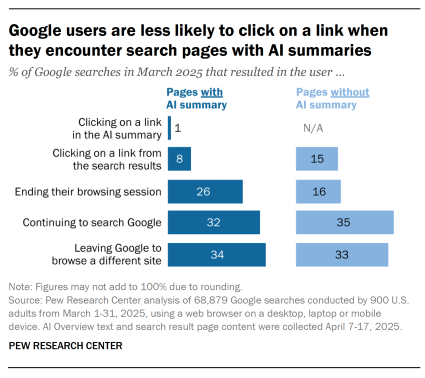
- Zero-click is the new normal. Only 8% of users who encountered an AI summary clicked on a traditional search result link. Often, users are skipping a traditional search engine altogether. Success must be measured by how often and how favorably AI represents your mission.
- Authenticity is a ranking signal. AI systems reward clarity, transparency, and credibility: the same qualities that define effective social impact communication. Purpose-driven marketers are uniquely positioned to win in this environment.
- The new goal is for AI to find your campaign. Understanding GEO and AEO is critical to maintaining shared voice, relevance, and trust in your program and organization.
What makes AI answers different?
Historically, SEO has been built around one goal: getting people to click through to your site. Rankings were won through keyword matching, content depth, backlinks, and UX signals. That model has been steadily, not suddenly, disrupted.
Now, generative engines provide answers to queries by synthesizing information from across the open web. Optimizing for agentic discovery is becoming the new norm. As click-through rates decline, zero-click strategies are becoming the new baseline for visibility.
Here’s the critical reframe: declining clicks don’t mean declining opportunity; they mean the opportunity has moved. AI-curated answers are the new opportunity for front door to campaign discovery. Being cited or recommended in an AI response now carries the same weight (often more) than a top organic ranking once did.
GEO and AEO: Know the Difference
These terms get used interchangeably, but they’re not identical. Purpose-driven marketers need to know the difference so that you can optimize for both.
| Answer Engine Optimization (AEO) | Generative Engine Optimization (GEO) |
| Direct, concise answers | Conversational responses |
| Featured summary at the top of a traditional search engine | Iterative prompts and answers within an LLM platform |
| Speed over depth | Depth over speed |
What AI Rewards, and What It Ignores
Every LLM parses information differently. Answer engines like ChatGPT, Perplexity, and Gemini draw from many of the same sources, but they process questions in different ways. ChatGPT provides long-form essays to explain its logic; Gemini and Perplexity seek out clear, concise, citable sources.
Queries directly to AI platforms (i.e., GEO) are longer, and sessions are deeper, than AI summaries at the top of traditional search engines.
The same organization can dominate in one model and disappear in another because each one is pulling different signals.
The way to make sure you’re visible in multiple models? Diversify your presence across the platforms your audience actually uses, and build the kind of credible, widely-cited content that earns trust across all of them.
How can purpose-driven marketers leverage this system?
Marketers want their clients and campaigns to show up in “position zero”: a search summary or AI Overview.
Content at the midpoint and bottom of the funnel is now the most direct route into AEO responses. Top-of-funnel educational content is not obsolete, but it shouldn’t dominate your strategy. The shift is from volume to value.
For purpose-driven marketers, this might mean:
- Comparison tables for nonprofit programs
- How-to guides
- Beneficiary testimonials
Five Steps to Winning in AEO and GEO
This is where purpose-driven marketers have a genuine edge. Clear missions, authentic storytelling, and community-rooted credibility are exactly what AI systems reward.
Here’s how purpose-driven marketers can build their zero-click strategies.
- Structure content for machine readability
- Use schema markup, FAQ formats, and bulleted lists. AI agents extract tokens, entities, and fields to read a website.
- Break long-form content into easily scannable sections with descriptive subheadings. AI prioritizes content that is well-organized, dense and specific, and easy to parse.
- For purpose-driven campaigns, make calls to action explicit (e.g. donation instructions or program eligibility criteria). If AI can’t parse the call to action, it won’t include the call to action.
- Build expert, citable content
- Publish original research and unique perspectives.
- Include author bios with credentials to demonstrate experience and expertise.
- Build content clusters: interconnected pieces that explore a topic from different angles.
- Enrich your content with visuals: charts, infographics, and transcribed video can boost visibility and engagement.
- Go omnichannel to signal your authority.
- AI synthesizes information across the entire web. Your campaign execution strategy should match.
- Become a part of the bigger conversation. Collaborate with thought leaders through blog posts, podcast features, or organic social media mentions. AI is tracking metrics like off-site signals and how often other AI queries have cited your content to determine your credibility. Give it more to work with.
- Standardize the info about your organization across review platforms, niche industry sites, and professional networking sites, to create consistency for AI readers.
- Unify paid and organic strategy.
- Align campaign targeting with user intent patterns, rather than just keyword matches (like traditional SEO). Conversational queries are longer and more detailed.
- Test, measure, and iterate.
- Experiment with GEO. Query ChatGPT, Perplexity, Gemini, and Claude about your own organization. What does AI say about you? What other organizations or campaigns appear alongside you?
- Establish AI visibility benchmarks and track them quarterly.
The Strategic Imperative
We’re not writing for keywords anymore. We’re writing for a system that makes informed recommendations.
For purpose-driven marketers, the stakes are especially high. Your missions, programs, and calls to action need to be visible and citable in the AI ecosystem that now shapes people’s decision-making processes.
Every citation strengthens your authority in the field.
Every positive mention builds trust.
Every data point helps to optimize your visibility.
| How Magnitude of Change Can Help We’re helping purpose-driven marketers navigate the AI search transition with some of our core capabilities: AI Visibility Measurement: We can partner with tracking infrastructure to assess your AI Visibility Rate, Citation Share, and Sentiment across ChatGPT, Perplexity, Gemini, and Claude, so you know how AI is representing your mission. Omnichannel Campaigns for Improved AI Visibility: We can develop audience-focused omnichannel campaigns to ensure your content reaches users where they are most active online and improves the visibility of your program or organization in AI searches. Ready to improve where you stand? |
Sources: Pew Research(2025), Forbes(2025a), PR Daily(2025), a16z(2025), Tinuiti(2026), Digiday(2025), WARC(2026a), WARC(2026b), Fast Company(2025), Forbes(2026), Wired(2025), New York Magazine(2025), Forbes(2025b), PR Newswire (2025), Try Profound(2025)